
From the blog
Why Typos on a Supplement Facts Panel Matter
A Supplement Facts panel is a regulated document with fixed headings and units, not a piece of marketing copy. Errors on it are not stylistic — they signal how carefully the label was checked. On the Jellyblue panel there are five: “Ashwaganda”, “Horney goat weed”, “gr” where grams are meant, “Serving per Container”, and “Total Calories”. The seller’s advertising spells the two ingredients correctly.
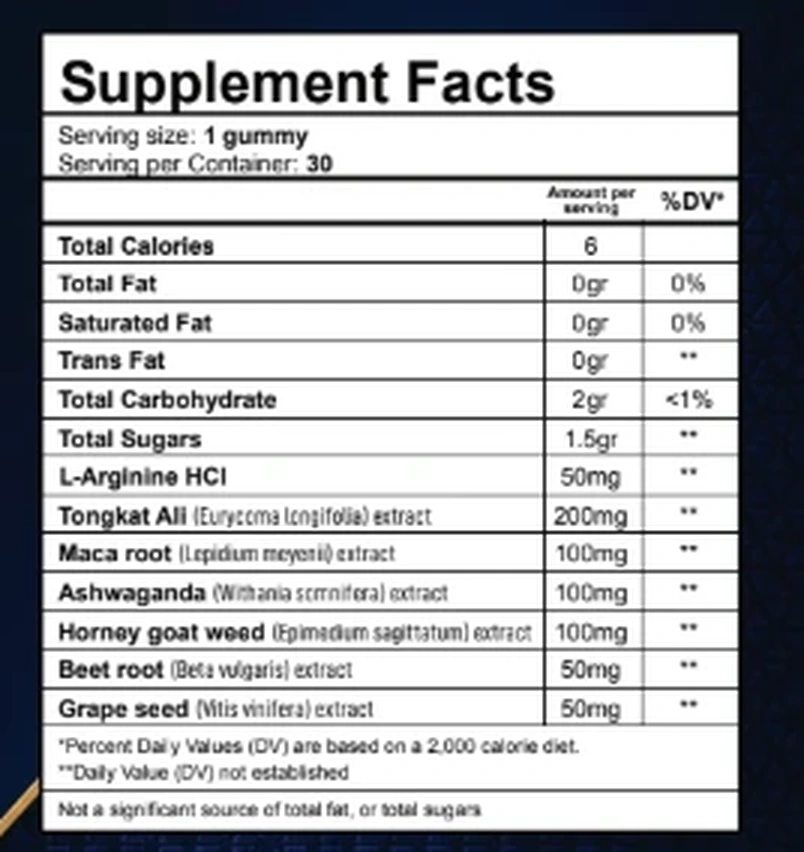
The panel is not a poster
There are two kinds of text on a supplement bottle, and they are governed by different rules.
The front is advertising. It can say “premium formula” and “maximum strength” and carry as many asterisks as the designer likes, because those words have no legal definition and the asterisk points at a disclaimer that covers them.
The back is a Supplement Facts panel, and it is a prescribed format. The headings, the order of the rows, the units, the footnotes and the way amounts are expressed are all specified. It exists so that a buyer, a pharmacist, a competitor or a regulator can read any two products the same way (U.S. Food and Drug Administration, “Dietary Supplement Labeling Guide, Chapter IV: Nutrition Labeling”).
That is why a typo on the front is a shrug and a typo on the back is information. One is a designer being loose with a slogan. The other is a regulated document that nobody checked.
Five errors on one panel
Here are the five on the Jellyblue label, in the order they appear, each checkable against the photograph at the top of this page.
| As printed | Should read | What kind of error |
|---|---|---|
| Serving per Container: 30 | Servings per Container | A prescribed heading, one letter short |
| Total Calories | Calories | A prescribed heading with an extra word |
| 0gr, 2gr, 1.5gr | 0 g, 2 g, 1.5 g | The wrong unit abbreviation |
| Ashwaganda | Ashwagandha | A misspelled ingredient name |
| Horney goat weed | Horny goat weed | A misspelled ingredient name |
None of these makes the product unsafe. Nobody is going to take the wrong amount because a heading is missing an “s”. That is not the argument.
The argument is that a Supplement Facts panel is the one part of the package where precision is the whole job, and five errors on a single panel is a measurement of how much attention the job got.
What “gr” actually means
One of the five deserves its own section, because it is the only one with a genuine potential for confusion.
The panel writes weights as “0gr”, “2gr” and “1.5gr”. The intended unit is grams, which is abbreviated “g”.
“gr” is the abbreviation for a grain — an old apothecaries’ unit still used occasionally in pharmacy, equal to about 64.8 milligrams. It is not obscure to the point of irrelevance: aspirin was sold in 5-grain tablets for most of a century, and some thyroid medication is still dosed in grains today.
So “2gr” of carbohydrate, read literally, is about 130 milligrams rather than two grams — a fifteen-fold difference. Nobody reading this panel in practice will be misled, because the context makes grams obvious and nutrition panels are always in grams. But it is precisely the kind of ambiguity a prescribed format exists to eliminate, and the fix is deleting one letter.
| Written | Means | In milligrams |
|---|---|---|
| 2 g | Two grams | 2,000 mg |
| 2 gr | Two grains | ~130 mg |
| 2 mg | Two milligrams | 2 mg |
| 2 mcg | Two micrograms | 0.002 mg |
The detail that makes this worth writing about
Two of the five errors are misspelled ingredient names: “Ashwaganda” and “Horney goat weed”.
Now look at the seller’s own marketing graphic, the one titled “Inside Jellyblue”. It names six ingredients, each with a photograph and a Latin binomial. It spells Ashwagandha correctly. It spells Horny Goat Weed correctly.
So the advertisement was proofread and the label was not. That is the wrong way round, and it is the single most telling fact on this page. The document that exists to persuade you received the attention; the document that exists to inform you did not.
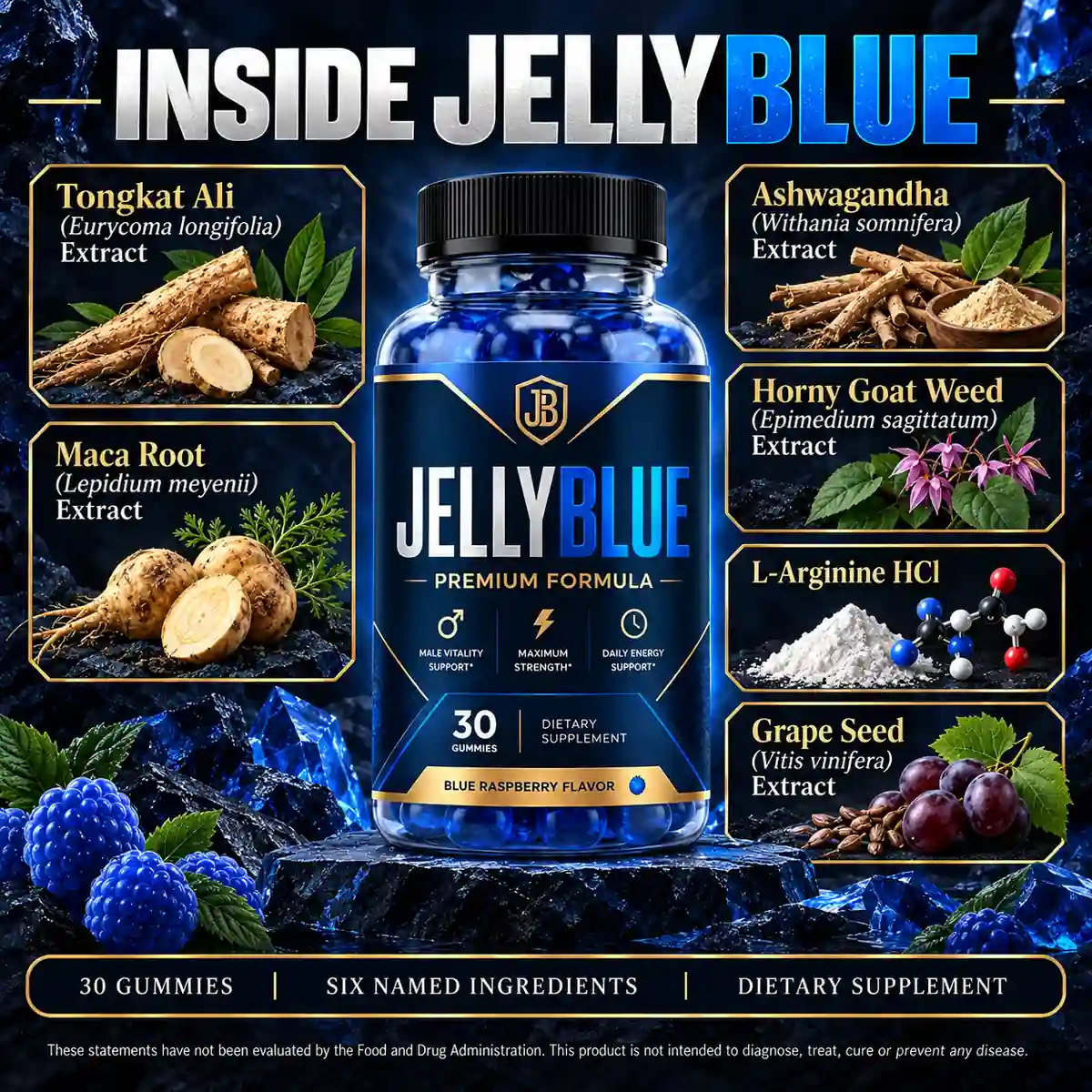
There is a charitable reading, and it is probably the true one. Marketing artwork and label artwork are usually made by different people, often at different companies, and the label is frequently supplied by a contract manufacturer while the graphics are made in-house. The agency that built the advertisement had a designer and a copywriter; the panel was typeset once and printed.
That reading explains the error without excusing it, because it is also the explanation for every other mismatch on this product — including an ingredient that appears on the panel and in none of the pictures.
Read the Jellyblue panel for yourself, typos and all.
Check today’s priceThe sixth thing, which is not a typo
There is one more problem with this panel, and it is a different species from the other five, because it is an omission rather than a misprint.
The panel declares Total Sugars 1.5 g. It does not print an “Includes … Added Sugars” line. And the other-ingredients line, two inches below, begins: cane sugar, glucose syrup.
Added sugar is a separate declaration from total sugar, and the distinction is the entire point: sugars naturally present in an ingredient are treated differently from sugars put in during manufacture. On a chewable sweetened with cane sugar and glucose syrup, essentially all of the sugar is added sugar, and a reader who is counting added sugar has no line to read (American Heart Association, “Added Sugars”).
A gummy at 1.5 g of sugar and 6 calories is at the light end of the category. The line it does not print sits underneath: cane sugar and glucose syrup are the first two other-ingredients, so some of that sugar is added sugar, and the panel prints no “Includes … Added Sugars” row at all.
And directly beneath the sugars row, the panel prints: “Not a significant source of total fat, or total sugars.” It has declared 1.5 g of total sugars two lines above. Both statements cannot be doing useful work at once.
To be fair to the product, 1.5 g is genuinely modest — plenty of gummies carry two or three times as much, and six calories is about as light as a chewable gets. The criticism is of the declaration, not the quantity.
How to check any panel in two minutes
This is a transferable skill, and it is faster than it sounds. Here is the sequence.
Read the headings
“Serving size”, “Servings per container”, “Amount per serving”, “Calories”. They are prescribed. Variations are a signal.
Read the units
g, mg, mcg, IU. Anything else — gr, gm, mgs — was typed rather than specified.
Spell-check the ingredients
Botanical common names are easy to get wrong and easy to check. A misspelled ingredient is a proofreading failure you can see from the shelf.
Look for the added-sugars line
If sugars are declared and the other-ingredients line names a sweetener, the added-sugars row should be there.
Check the Latin names
Not whether they look impressive — whether they are present and correct. They are how anyone knows which plant is in the bottle.
Compare with the advertising
Same ingredients? Same count? Same spellings? A difference tells you the two were made separately.
The fair conclusion
It would be easy to finish this post by treating five typos as a verdict on the product, and that would be overreaching. Jellyblue has the most transparent label this desk has written up: seven active ingredients, seven printed amounts, no proprietary blend, six correct Latin binomials, a full other-ingredients line and a named gelling agent. One of its amounts is at a dose research actually used.
A company that did all of that deliberately is not trying to hide anything. It is a company that got the substance right and the setting wrong.
What the typos tell you is narrower, and worth knowing: the panel on this bottle was not read carefully by anyone before it was printed thousands of times. On a document whose entire purpose is accuracy, that is the thing to weigh — not because a missing “h” is dangerous, but because it is the only evidence you have about how the rest of the process was run.
Sources
- U.S. Food and Drug Administration. Dietary Supplement Labeling Guide, Chapter IV: Nutrition Labeling. FDA guidance for industry. Link checked for the September 30, 2026 revision.
- U.S. Food and Drug Administration. Dietary Supplements: What You Need to Know. FDA, current revision. Link checked for the September 30, 2026 revision.
- National Center for Complementary and Integrative Health. Ashwagandha. NCCIH, current page. Link checked for the September 30, 2026 revision.
- Memorial Sloan Kettering Cancer Center. Epimedium / Horny Goat Weed (About Herbs). MSK integrative medicine database. Link checked for the September 30, 2026 revision.
- American Heart Association. Added Sugars. AHA, current page. Link checked for the September 30, 2026 revision.
Questions on this topic
More answers on the full FAQ page.
Is a typo on a supplement label illegal?
The format of a Supplement Facts panel is prescribed, including headings and units. Whether a particular deviation matters legally is a question for a regulator; what it tells a buyer is how carefully the label was checked.
What does “gr” mean on a label?
It is the abbreviation for a grain, an apothecaries’ unit of about 64.8 milligrams. Where a nutrition panel means grams, the correct abbreviation is “g”.
Why does a misspelled ingredient matter?
On its own, very little. As evidence, it tells you the regulated document was not proofread — especially when the advertising spells the same word correctly.
What is an added-sugars line?
A separate declaration for sugar added during manufacture, as opposed to sugar naturally present in an ingredient. It should appear when a product is sweetened.
Do the typos mean Jellyblue is a bad product?
No. The same label itemises every amount, prints correct Latin names and gets one dose right. The typos tell you about the care taken over the printing, not about what is in the gummy.
Ready to try Jellyblue?
Pick a pack and see the price at checkout. The money-back guarantee is 60 days from purchase, unless the sales page prints a longer window. Questions first? Contact the order desk.
Sold through a USA Authorized Jellyblue Retailer. This site is not the manufacturer and earns when you buy.Keep reading
What makes a dose real
How to tell a working amount from a name on an ingredient list: the two-number test, extra…
Read more →What free bonuses are worth
Why sellers stack free ebooks, what a “$97 value” means, how review avatars and named-expe…
Read more →Jellyblue ingredients
All seven actives, with the amounts printed on the panel.
Read more →