
Official product information
Choosing a Men’s Gummy
To choose a men’s performance product, read the Supplement Facts panel, insist on an amount beside every ingredient, compare each amount with the dose used in research, look for a standardisation percentage, and check the other-ingredients line for the gelling agent.
The seven-point checklist
This works for any men’s performance product, gummy or capsule. It takes a couple of minutes and removes most bad purchases before you have spent anything.
Turn the bottle around
The front is advertising. The Supplement Facts panel is the regulated part, and it is where the amounts live.
Look for an amount beside every name
A proprietary blend gives one total and hides the rest. On a product sold for a specific outcome, that is a reason to put it down.
Compare each amount with the studied dose
This is the whole exercise. Search the ingredient plus “dose”, read the first lines of a trial abstract, and put the two numbers side by side.
Compare each amount with the studied dose
Search the ingredient plus “dose” plus the outcome. Two minutes settles most purchases.
Check for standardisation
“Horny goat weed 300 mg” and “standardised to 20% icariin, 300 mg” are different products.
Check the other-ingredients line
On a gummy this tells you the gelling agent — pectin or gelatin — the sweetener and the colour. If it is missing, so is your ability to check anything.
Check the seller
A phone number, a returns address, a lot code and a printed expiry date.
How Jellyblue scores on the checklist
| Point | Jellyblue |
|---|---|
| Panel shown | Yes, in full |
| Amount beside every name | Yes. Seven actives, seven amounts, totalling 650 mg |
| No proprietary blend | Correct. There is none |
| Amounts match studied doses | One of seven. Tongkat ali at 200 mg is inside the range; five are well below |
| Standardisation | None stated for any of the six botanicals |
| Other-ingredients line | Yes, printed in full. Pectin, so the vegetarian badge is true |
| Seller details | Yes: an order desk, a returns address and a lot code. No expiry date visible in the photographs |
Five out of seven, which is the best score this desk has given. It fails on standardisation, which almost everything fails on, and it half-passes on doses: one ingredient lands and five do not. What it gets right is the part that lets you check the rest.
The two-number test, and how to use it
If you take one habit from this page, make it this one. Put the label amount and the studied amount next to each other, in the same units, and read the ratio.
| On a label | Research uses | Ratio | Verdict |
|---|---|---|---|
| Tongkat ali 200 mg | 200–400 mg | 1:1 to 1:2 | Inside the range |
| Ashwagandha 100 mg | 300–600 mg | 1:3 to 1:6 | Below, same order of magnitude |
| Grape seed 50 mg | 100–300 mg | 1:2 to 1:6 | Below, same order of magnitude |
| Maca 100 mg | 1,500–3,000 mg | 1:15 to 1:30 | A name on a list |
| L-arginine 50 mg | 3,000–6,000 mg | 1:60 to 1:120 | A name on a list |
Notice what the ratio column does. It removes the arguing. You do not have to decide whether maca “works” to conclude that 100 mg is not the amount anybody tested, and you do not have to be impressed by tongkat ali to notice that 200 mg is.
The one thing the ratio cannot capture is extract strength. Two products can both print 100 mg of ashwagandha and differ several-fold in withanolide content, which is why a standardisation percentage is the number that finishes the job. Very few labels in this category print one.
Red flags on any men’s product
- “FDA approved.” No supplement is.
- A promise to raise testosterone by a number.
- Botanicals quoted in micrograms.
- A proprietary blend on a product sold for a specific outcome, especially when the total is small.
- An ingredient list in the marketing that is shorter than the one on the panel.
- Typos on the Supplement Facts panel, which is a regulated document rather than a poster.
- A stack of free ebooks doing the work the ingredient amounts should be doing.
- Before-and-after physiques in the marketing.
- Unnamed doctors and unnamed laboratories.
- Countdown timers and “only 3 bottles left” on a shelf-stable product.
- Any suggestion you could skip a doctor for a symptom that is new or worsening.
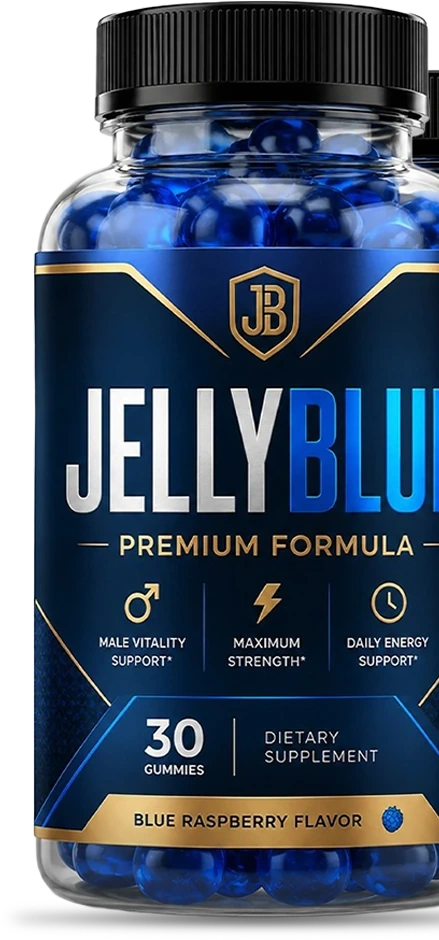
Been through the list? See the Jellyblue packs and decide with your eyes open.
Check today’s priceChoosing: questions
More answers on the full FAQ page.
Is there a proprietary blend?
No. Every active ingredient carries its own amount. That is genuinely uncommon in this category and it is the best thing about this label.
Which amounts are real doses?
One. Tongkat ali at 200 mg sits inside the 200–400 mg range trials of a standardised extract usually use. The other six are below their studied ranges — ashwagandha and grape seed by a factor of three to six, maca and L-arginine by far more.
What are the other ingredients?
Printed in full on the label: cane sugar, glucose syrup, water, pectin, citric acid, sodium citrate, natural flavor, natural coloring, starch.
Is it vegetarian?
Yes, on the evidence of the label. The other-ingredients line is printed in full and the gelling agent is pectin, not gelatin. That is the first thing to check on any gummy, and this one passes.
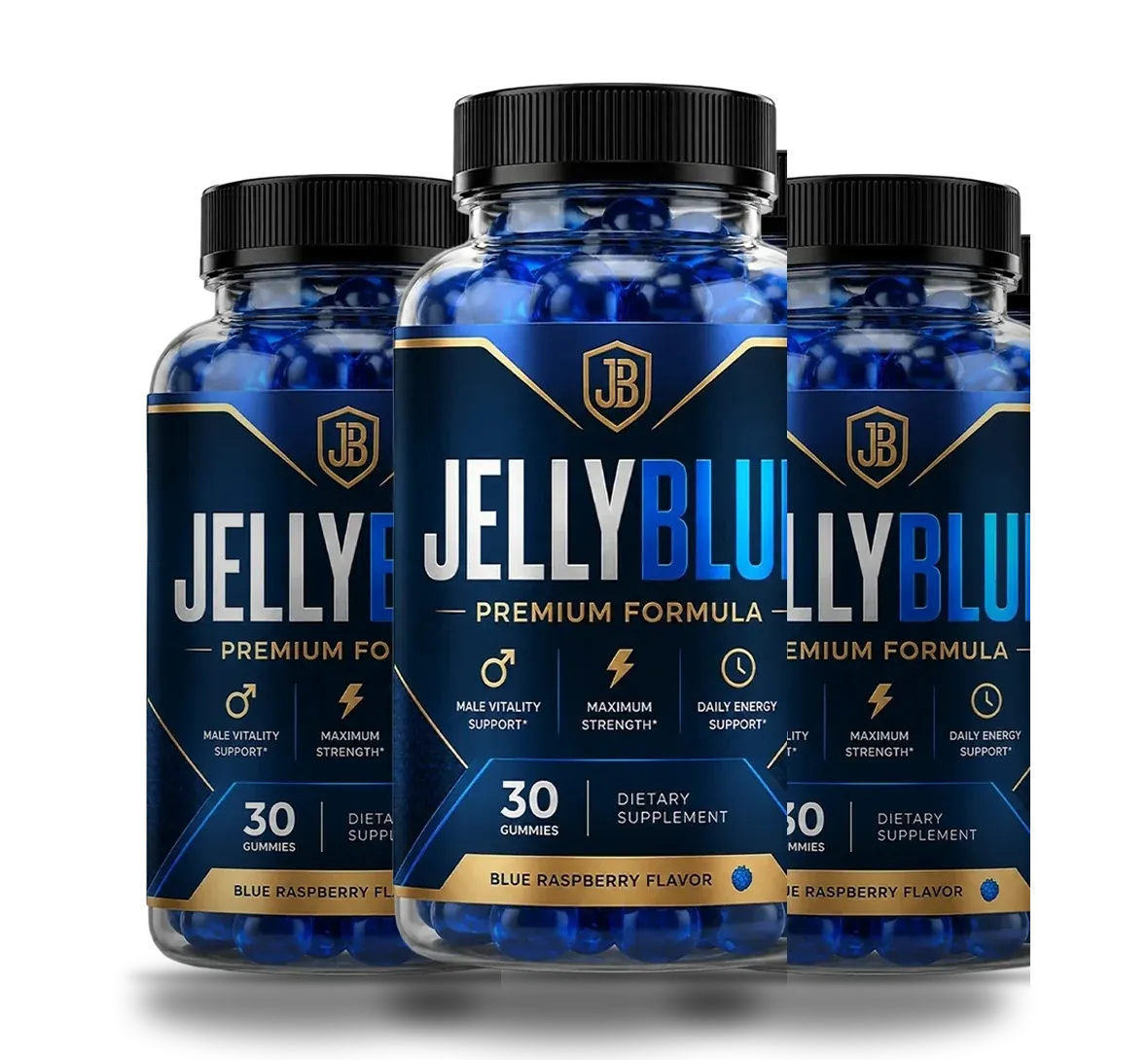
Ready to try Jellyblue?
Pick a pack and see the price at checkout. The money-back guarantee is 60 days from purchase, unless the sales page prints a longer window. Questions first? Contact the order desk.
Sold through a USA Authorized Jellyblue Retailer. This site is not the manufacturer and earns when you buy.