
From the blog
Jellyblue Dosage: Jellyblue® Dosage: #1 Guide to What Makes a Dose Real [2026]
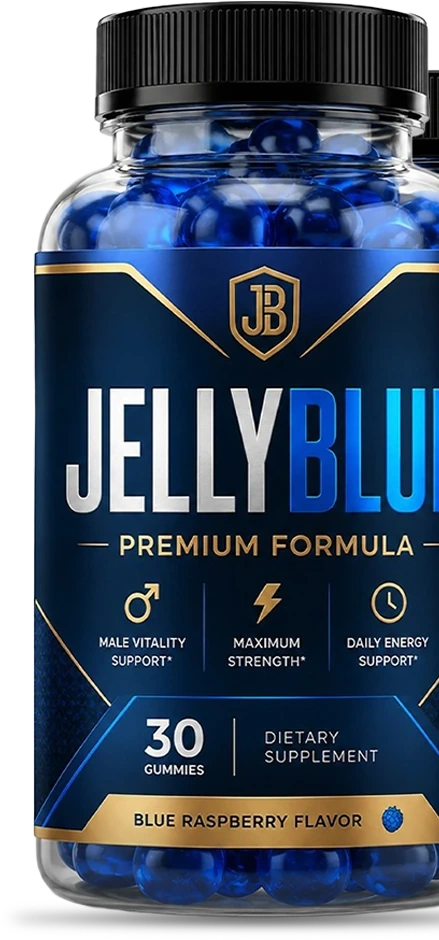
The Jellyblue dosage is one gummy a day with an 8 oz glass of water, ideally 20 to 30 minutes before a meal, and the label says not to exceed it. That one gummy holds 650 mg of seven actives. A dose is real when the label amount matches what research used: tongkat ali at 200 mg passes, ashwagandha and grape seed come close, and maca, L-arginine and beet root fall far short.
The question nobody asks at the shelf
Standing in a shop, or on a product page, almost everyone reads a supplement label the same way. They read the names. Tongkat ali, ashwagandha, maca, horny goat weed — six or seven ingredients that sound like they belong together, arranged in a list, with a photograph of a root beside each one.
Almost nobody reads the numbers, and the numbers are the entire product.
This is not a failure of intelligence. It is a design outcome. The names are set in large type on the front of the bottle and repeated in every advertisement; the numbers are set in six-point type on the back, in a box, next to a percentage sign that usually says nothing. The label is built so that the names do the persuading and the numbers do the complying.
So here is the habit worth building, and it takes about ninety seconds per product.
Where the second number comes from
The label gives you the first number. The second one — what research actually used — takes two minutes and a search box, and it is more available than people expect.
Search the ingredient name plus the word “dose”, or the ingredient plus the outcome you care about. The abstract of almost any clinical trial states its dose in the first three lines, because that is the first thing another researcher needs to know. Review pages at NCCIH, NIH’s Office of Dietary Supplements and Memorial Sloan Kettering summarise the usual ranges in plain English without requiring you to read a paper.
What you are looking for is a range rather than a single figure, because doses differ between trials. For most botanicals the range is narrow enough to be useful: ashwagandha clusters around 300 to 600 mg a day, tongkat ali around 200 to 400 mg, grape seed around 100 to 300 mg.
| Ingredient | Where the range comes from | Typical daily dose in trials |
|---|---|---|
| Tongkat ali | Memorial Sloan Kettering Cancer Center, “Tongkat Ali / Eurycoma longifolia (About Herbs)” | 200–400 mg of a standardised extract |
| Ashwagandha | National Center for Complementary and Integrative Health, “Ashwagandha” | 300–600 mg of root extract |
| Maca | National Center for Complementary and Integrative Health, “Maca” | 1,500–3,000 mg |
| L-arginine | Memorial Sloan Kettering Cancer Center, “Arginine (About Herbs)” | 3,000–6,000 mg |
| Beetroot / nitrate | NIH Office of Dietary Supplements, “Dietary Supplements for Exercise and Athletic Performance” | Juice or concentrate giving ~400 mg of nitrate |
Notice how wide the spread is between rows. Two of those numbers are in the hundreds of milligrams and two are in the thousands. An ingredient list gives all five equal billing; the doses do not.
Reading the ratio
Once you have both numbers, the division tells you which of three categories a product is in. The boundaries are not laws of nature, but they are a fair working guide.
| Ratio of label to studied dose | What it means | Example |
|---|---|---|
| 1:1 to 1:2 | A real dose. The product contains what the research used | Tongkat ali 200 mg against 200–400 mg |
| 1:3 to 1:6 | Below the range, same order of magnitude. A stronger extract could partly close the gap | Ashwagandha 100 mg against 300–600 mg |
| 1:10 to 1:50 | A gesture. Present for the ingredient list | Maca 100 mg against 1.5–3 g |
| Worse than 1:50 | A name, not an ingredient | L-arginine 50 mg against 3–6 g |
| No number at all | A proprietary blend. The question cannot be answered | Any “performance matrix, 500 mg” |
The middle row is the one worth dwelling on, because it is where most arguments happen. A product at a third of a studied dose is not nothing. It is also not what was tested, and a supplement’s entire claim to work rests on the research that was done on the amount that was tested. When somebody tells you “it still has an effect at lower doses”, the correct response is to ask which trial found that, at which dose.
The bottom row is the one worth being blunt about. There is no reading of the evidence under which 50 mg of L-arginine does what three grams does. It is not a weaker version of the same effect; it is a different quantity by two orders of magnitude, and the mechanism — converting arginine to nitric oxide at a rate that changes blood flow — is dose-dependent in a way that does not scale down gracefully.
The thing the ratio cannot see
There is one honest complication, and any page that skips it is selling you something.
A herbal extract is not a standard substance. “100 mg of ashwagandha root extract” describes a weight of powder, not a quantity of the compounds that made ashwagandha interesting. Two suppliers can both sell that powder and differ several-fold in withanolide content, depending on the solvent used, the part of the plant, the growing conditions and the drying process.
This is why the best labels print a second number: a standardisation. “Ashwagandha root extract, 600 mg, standardised to 5% withanolides.” That phrase closes the loop, because trials report their doses the same way, and it turns a weight into a quantity of the active fraction.
The practical consequence cuts both ways. A product at a third of a studied dose, using an extract three times stronger than the one in the trial, might be delivering a comparable amount of the active compound — and a product at the full studied dose, using a weak extract, might not. Without a standardisation, neither claim can be checked.
What “more is better” gets wrong
The two-number test has a symmetrical failure mode that is worth naming, because supplement marketing exploits it constantly in the other direction.
More is not automatically better. Several ingredients in this category have ranges with a top as well as a bottom, and a few have an upper limit set by a health body. Vitamin D, zinc, selenium and iron are all examples where exceeding the studied amount is not an improvement but a risk. Even among botanicals, the trials that found an effect used a particular amount, and a product at five times that amount is as far outside the evidence as a product at a fifth of it.
So the target is not “as much as possible”. The target is “what the research used”, which is a much more specific and more useful thing to aim at, and it is why the ratio matters more than the raw milligrams.
Find the label amount
On the Supplement Facts panel, not the front of the bottle.
Find the studied range
Ingredient plus “dose”. Read a trial abstract or a summary page.
Divide
Same units. A ratio, not a feeling.
Check for a standardisation
A percentage of a named compound. Its absence caps what you can conclude.
Check for an upper limit
For vitamins and minerals especially. More is not a strategy.
See every Jellyblue amount, printed on the panel.
Check today’s priceRunning the test on Jellyblue
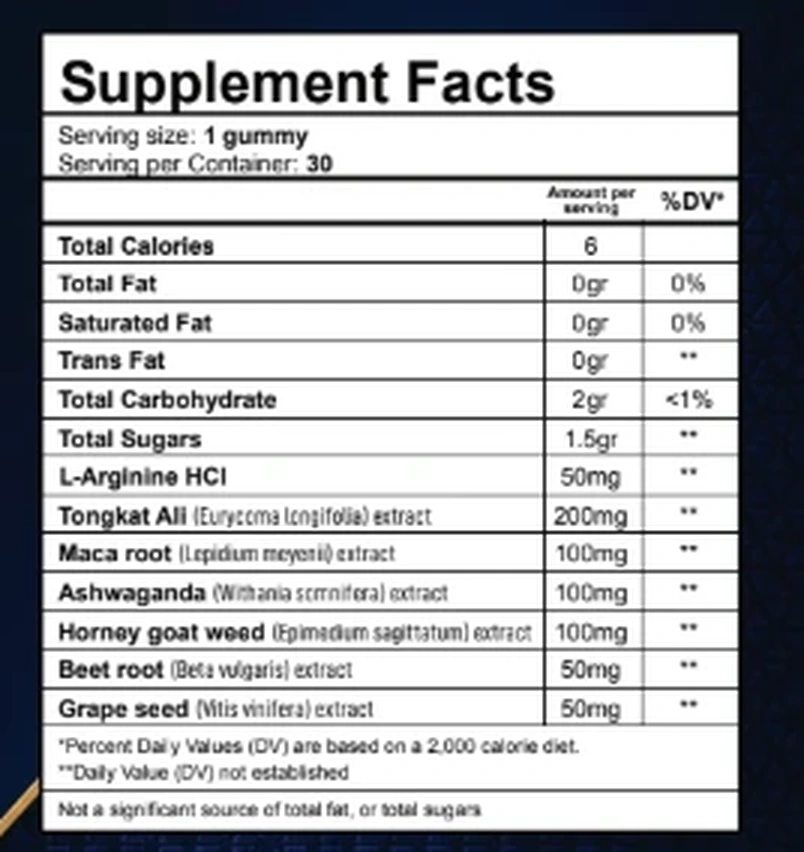
This site exists because this particular label makes the test easy. Every active ingredient carries an amount, there is no proprietary blend, and every botanical carries a correct Latin binomial. So here is the whole panel, run through the ratio.
- L-Arginine HCl3,000–6,000 mg a day in most trials50 mgA fraction of any studied amount
- Tongkat Ali200–400 mg a day of a standardised extract in most trials200 mgInside the range research uses
- Maca root1,500–3,000 mg a day in most trials100 mgA fraction of any studied amount
- Ashwagandha300–600 mg a day of root extract in most trials100 mgBelow the studied range, but the same order of magnitude
- Horny goat weedHundreds of milligrams in the little research there is100 mgBelow the studied range, but the same order of magnitude
- Beet rootStudies use juice or concentrate giving about 400 mg of nitrate, which is grams of material50 mgA fraction of any studied amount
- Grape seed100–300 mg a day, standardised for proanthocyanidins50 mgBelow the studied range, but the same order of magnitude
Trial ranges are the ones usually quoted for these ingredients. They are not studies of Jellyblue; no study of this product exists.
One row passes. Tongkat ali at 200 mg sits at the bottom of the 200 to 400 mg range that trials use, which makes it the first ingredient on any label this desk has written up to land inside a studied range rather than under it. Two rows are close: ashwagandha at a third of its range, grape seed at a half to a sixth of its.
Three rows are not close, and one of them — beet root at 50 mg against research that uses grams of juice — is not close by a distance that no extract strength could bridge.
This is the first amount on any of these labels that lands inside a studied range rather than below it. It sits at the bottom of that range, and the label does not say whether the extract is standardised — but 200 mg is a number a researcher would recognise.
Why this is worth doing at all
It would be reasonable to ask whether any of this matters, given that the honest answer for most of this category is “probably nothing either way”.
It matters for three practical reasons. First, money: you are paying for seven ingredients and receiving a meaningful quantity of one. Knowing that changes what a fair price looks like. Second, comparison: once you can read a ratio, you can put a multi-ingredient gummy next to a single-ingredient capsule and see which one actually contains the thing you wanted. Third, safety: the ingredients that interact with medicines do so at the doses that work, and knowing which amounts on a label are real is the same skill as knowing which ones a pharmacist needs to hear about.
And there is a fourth reason, less practical and more stubborn. A supplement label is a document a company chose to print. Reading it carefully is the only feedback mechanism this market has (U.S. Food and Drug Administration, “Dietary Supplements: What You Need to Know”).
The bottom line
A dose is real when the amount on the label is the amount that was studied. The test is a division, the second number is two minutes away, and the answer is usually clearer than the marketing would like.
On this label, one of seven passes and five do not. That is a better result than most products in this category manage, and it is a result you can only reach because the label printed the numbers in the first place.
Sources
- Memorial Sloan Kettering Cancer Center. Tongkat Ali / Eurycoma longifolia (About Herbs). MSK integrative medicine database. Page no longer available from its publisher (link checked for the September 30, 2026 revision).
- National Center for Complementary and Integrative Health. Ashwagandha. NCCIH, current page. Link checked for the September 30, 2026 revision.
- Memorial Sloan Kettering Cancer Center. Arginine (About Herbs). MSK integrative medicine database. Link checked for the September 30, 2026 revision.
- National Center for Complementary and Integrative Health. Maca. NCCIH, current page. Page no longer available from its publisher (link checked for the September 30, 2026 revision).
- NIH Office of Dietary Supplements. Dietary Supplements for Exercise and Athletic Performance. NIH ODS, current revision. Link checked for the September 30, 2026 revision.
- U.S. Food and Drug Administration. Dietary Supplements: What You Need to Know. FDA, current revision. Link checked for the September 30, 2026 revision.
Questions on this topic
More answers on the full FAQ page.
How do I find the dose used in research?
Search the ingredient name plus “dose”. Trial abstracts state it in the first few lines, and NCCIH, NIH ODS and Memorial Sloan Kettering summarise the usual ranges in plain English.
Is a third of a studied dose worth anything?
Possibly, and it was not what was tested. A stronger extract could partly close the gap, but only a standardisation percentage would let you check that.
What is a standardised extract?
One guaranteed to contain a stated percentage of a named compound, such as 5% withanolides. It turns a weight of powder into a quantity of the active fraction.
Which Jellyblue ingredient is at a real dose?
Tongkat ali, at 200 mg. Trials of a standardised extract usually use 200 to 400 mg a day.
Is more always better?
No. Several ingredients have an upper limit as well as a lower one, and the target is the amount research used rather than the largest number on a shelf.
Ready to try Jellyblue?
Pick a pack and see the price at checkout. The money-back guarantee is 60 days from purchase, unless the sales page prints a longer window. Questions first? Contact the order desk.
Sold through a USA Authorized Jellyblue Retailer. This site is not the manufacturer and earns when you buy.Keep reading
Why label typos matter
A Supplement Facts panel is a regulated document, not a poster. What five printing errors …
Read more →What free bonuses are worth
Why sellers stack free ebooks, what a “$97 value” means, how review avatars and named-expe…
Read more →Jellyblue ingredients
All seven actives, with the amounts printed on the panel.
Read more →