
From the blog
Jellyblue label: what does each printed word mean?
The Jellyblue label has a front panel, a directions block and a Supplement Facts box. This glossary explains each printed term: the serving, the calories and sugars, the seven actives that total 650 mg, the other ingredients and the footnote. Every fact comes from the label itself, and anything it does not print is marked not published.
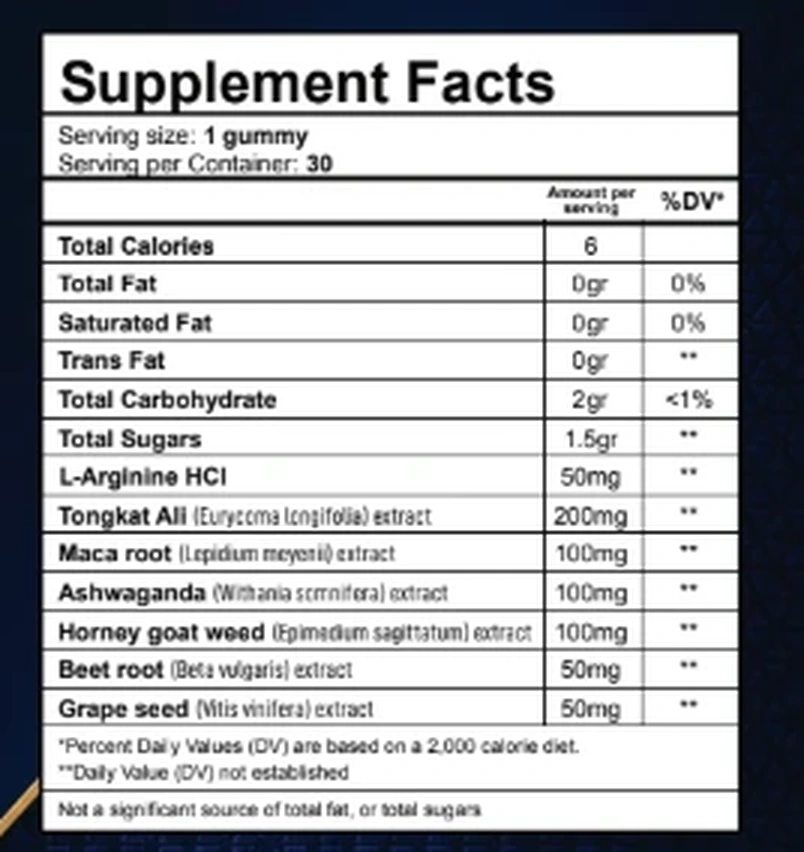
The Jellyblue label is short, but every line on it has a job. Some lines tell you what is inside. Some lines are legal wording. A few lines are small mistakes. This page works like a glossary, so you can look up a word and see what it means on this bottle.
We read the label, not the advertising. Where the label is silent, we say not published instead of guessing. If you want the full panel in table form, our supplement facts page prints it row by row.
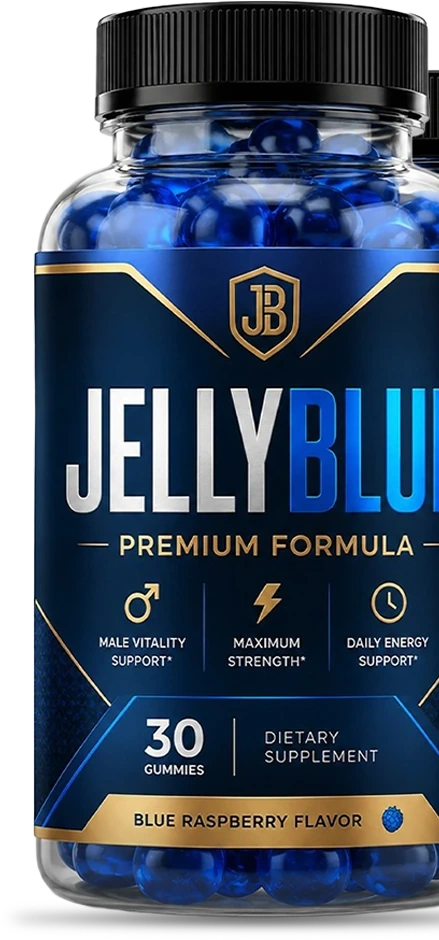
What is on the front of the Jellyblue label?
The front is plain. It shows the name, a gold JB crest on a navy bottle, and a few short phrases. Here is each phrase and what it is.
| Printed words | What it is |
|---|---|
| Male Vitality Support | A claim with an asterisk. It points to the standard supplement disclaimer. It is not a promise of a result. |
| Maximum Strength | A marketing phrase. It is not tied to a number on the panel. |
| Daily Energy Support | A claim with an asterisk. The panel lists no stimulant. |
| Premium Formula | The product name printed under the brand. |
| 30 Gummies | The count in one bottle. At one a day, that is 30 days. |
| Dietary Supplement | The product type. It is not a drug. |
| Blue Raspberry Flavor | The flavour, printed along the base. |
Read the asterisks as a sign to look lower on the label. They lead to the disclaimer that the statements have not been evaluated by the FDA and that the product is not meant to diagnose, treat, cure or prevent any disease.
How do you read the serving lines on the Jellyblue label?
The serving size is 1 gummy. The next line says "Serving per Container" and prints 30. That heading is missing an s. It should say "Servings per Container". The meaning is still clear: one bottle holds 30 servings, so one bottle lasts 30 days at one gummy a day.
The directions block gives the routine. Take one gummy daily with an 8 oz glass of water. For best results, take it 20 to 30 minutes before a meal, or as your healthcare professional directs. It also says not to go past the recommended dose.
Our post on why typos on a supplement facts panel matter explains why small wording slips are worth noticing, even when the meaning is clear.
Want to see the label facts first?
The seven amounts, the pectin and the 60-day money-back window are all on the public pages. You can read them before you pay.
Sold through a USA Authorized Jellyblue Retailer. This site is not the manufacturer and earns when you buy.What do the nutrition rows on the Jellyblue label mean?
The top of the panel is a small nutrition block. One gummy has 6 calories. The panel prints "Total Calories" where the usual heading is just "Calories". Fat rows show zero. Total carbohydrate is 2 g, and total sugars are 1.5 g.
You will see "gr" after these numbers, not "g". On this label it stands in for grams, which is a printing slip. The percent figures in brackets refer to Daily Value. The footnote says Daily Value is based on a 2,000 calorie diet, and that a Daily Value is not established for some rows.
One more line is worth knowing. The footnote also says the product is not a significant source of total fat or total sugars. That sits right under a row that prints 1.5 g of total sugars. The two lines sit awkwardly together, and we point that out instead of hiding it.
What do the seven active lines on the Jellyblue label tell you?
Below the nutrition rows the panel lists seven actives. Each one has its own amount. There is no proprietary blend, which means no hidden split inside a single total.
| Printed name | Amount per gummy |
|---|---|
| L-Arginine HCl | 50 mg |
| Tongkat Ali | 200 mg |
| Maca root | 100 mg |
| Ashwagandha (printed "Ashwaganda") | 100 mg |
| Horny goat weed (printed "Horney goat weed") | 100 mg |
| Beet root | 50 mg |
| Grape seed | 50 mg |
The amounts add up to 650 mg. Two names are misspelled on the panel, as the table shows. The label does not state a standardisation for any extract. That means it does not say how strong each extract is.
What is in the other ingredients line?
Under the actives you will find the other ingredients, in label order: cane sugar, glucose syrup, water, pectin, citric acid, sodium citrate, natural flavor, natural coloring and starch. This line tells you what the gummy itself is made of.
- Cane sugar and glucose syrup come first, so sweetener is a large part of the gummy base.
- Pectin is the gelling agent. It is not gelatin, so the vegetarian badge can be checked against this line.
- Citric acid and sodium citrate are in the list. The label does not say what each one is for.
- Natural flavor and natural coloring are printed with no further detail.
Which words are missing from the Jellyblue label?
A good glossary also lists what is absent. These items are not printed on the Jellyblue label, so we cannot explain them.
- An "Includes ... Added Sugars" line, even though cane sugar and glucose syrup are declared.
- A standardisation for any of the six botanicals.
- A manufacturer name. The label prints a distributor: Gex Corporation LLP, PO Box 12730, Ogden, UT 84404.
- A certificate of analysis. The lot code is JEL-26/JE-7723, but it is a label code, not lab proof.
- A visible expiry date in the photographs we have. Check the base of the bottle you receive.
If one of these matters to you, ask the order desk before you buy a larger pack. The Jellyblue home page lists how to reach it.
Key facts
- Serving size is 1 gummy, and one bottle holds 30 gummies.
- One gummy has 6 calories, 2 g of carbohydrate and 1.5 g of sugars.
- Seven actives are listed with amounts. They total 650 mg per gummy.
- The gelling agent is pectin, not gelatin.
- Five printing slips appear on the panel, such as "Ashwaganda" and "gr".
- The label names a distributor, not a manufacturer.
- The label is not FDA approved, and no supplement is.
Frequently asked questions
What does Serving per Container mean on the Jellyblue label?
It tells you how many servings one bottle holds. The label prints 30, and one serving is one gummy, so a bottle gives 30 days at one a day.
Why does the Jellyblue label say gr and not g?
It is a printing slip. The rows use gr where grams are meant. The numbers still read as 2 g of carbohydrate and 1.5 g of sugars.
Does the Jellyblue label list a proprietary blend?
No. All seven actives have their own printed amounts. That lets you see the full 650 mg split.
Is there an expiry date on the Jellyblue label?
Not in the photographs we have. Check the base of your bottle when it arrives and ask the order desk if it is missing.
What do the asterisks on the Jellyblue label mean?
They point to the standard disclaimer. The claims have not been evaluated by the FDA, and the product is not meant to diagnose, treat, cure or prevent any disease.
Who is named on the Jellyblue label?
A distributor, Gex Corporation LLP of Ogden, Utah. No manufacturer is named. This site is run by a USA Authorized Jellyblue Retailer, not by the maker.
Our view
The Jellyblue label is better than many we read. Every active has an amount, the gelling agent is named, and the other ingredients are printed in full. The weak spots are small: spelling and unit slips, a missing added sugars line, and no standardisation.
Read the label before you read any page about it, including this one. Then take the printed numbers to a pharmacist or doctor if you use any medicine. This is a dietary supplement, it is not FDA approved, and it is not a treatment for any condition.
Ready to try Jellyblue?
The money-back guarantee is 60 days from purchase, unless the sales page prints a longer window. You see the price, tax and shipping at checkout before you pay. Questions first? Contact the order desk.
Sold through a USA Authorized Jellyblue Retailer. This site is not the manufacturer and earns when you buy.